
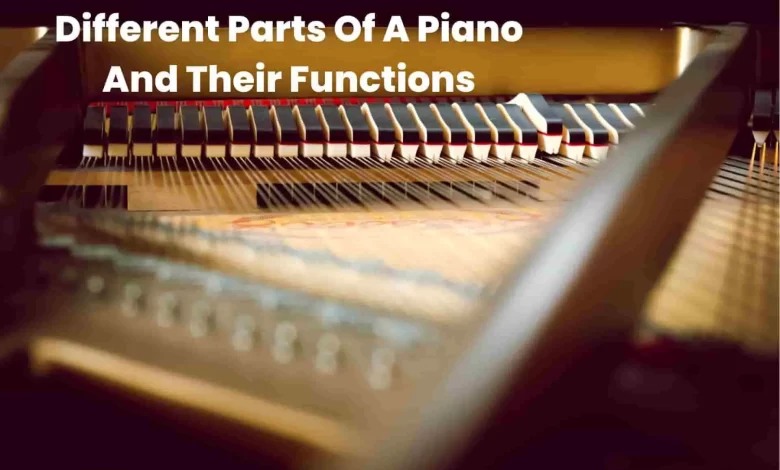
The piano has a rich history and has evolved to become the instrument we know today. Its importance in music cannot be overstated, making it essential to understand how it produces its sound. In this article, we will delve into the different parts of a piano and their functions in sound production. You will get complete guidance about piano parts as all digital pianos and others have similar parts usually.
1. Anatomy of a Piano
The piano is a complex instrument with many parts that work together to produce sound. Let’s take a closer look at each part and its function.

2. The Soundboard
The soundboard is a large, thin wooden board that covers the entire back of the piano. Its primary function is to amplify the vibrations of the strings, allowing the sound to resonate throughout the instrument and project outwards. The materials used in constructing a soundboard, such as spruce, have a significant impact on the sound of the piano.
What is the soundboard of a piano, and what is its role in sound production?
The soundboard is a large, thin wooden board that covers the entire back of the piano. Its primary function is to amplify the vibrations of the strings, allowing the sound to resonate throughout the instrument and project outwards.
How do the strings of a piano affect the sound produced?

The length, thickness, and tension of the strings affect the pitch and tone of the sound produced. The piano typically has three types of strings: bass, middle, and treble, each with a distinct thickness and length.
What are the hammers of a piano, and how do they contribute to sound production?
The hammers are small, felt-covered objects that strike the strings when a key is pressed. They are responsible for producing the sound of the piano. The material and shape of the hammers impact the sound produced. The harder the hammer, the brighter the sound, while softer hammers produce a warmer, mellower sound.
What are the pedals of a piano, and what do they do?
The pedals are located at the bottom of the piano and alter the sound produced by the instrument. The three pedals found on most pianos are the sustain pedal, the soft pedal, and the sostenuto pedal. The sustain pedal is the most commonly used and sustains the sound of the strings after a key is released. The soft pedal reduces the volume of the sound produced, while the sostenuto pedal sustains only specific notes.
How does understanding the different parts of a piano and their functions benefit musicians and music enthusiasts?
Understanding the different parts of a piano and their functions is essential for anyone who wants to learn to play the piano or appreciate its unique sound. With this knowledge, musicians can better understand how to produce different tones and sounds from the instrument, while music enthusiasts can better appreciate the complexity and beauty of the piano’s sound.
3. The Strings
The strings are the heart of the piano and are responsible for producing the sound. The length, thickness, and tension of the strings affect the pitch and tone of the sound produced. The piano typically has three types of strings: bass, middle, and treble, each with a distinct thickness and length.
4. The Hammers
The hammers are small, felt-covered objects that strike the strings when a key is pressed. They are responsible for producing the sound of the piano. The material and shape of the hammers impact the sound produced. The harder the hammer, the brighter the sound, while softer hammers produce a warmer, mellower sound.
5. The Pedals
The pedals are located at the bottom of the piano and alter the sound produced by the instrument. The three pedals found on most pianos are the sustain pedal, the soft pedal, and the sostenuto pedal. The sustain pedal is the most commonly used and sustains the sound of the strings after a key is released. The soft pedal reduces the volume of the sound produced, while the sostenuto pedal sustains only specific notes.
Whether an acoustic piano has more advantages than a digital piano, in recent decades digital piano comes with modern features that most people prefer. A digital piano gives latest technology features. Here is a list of some features of a digital piano:
Keyboard Action and Touch Response. One of the main differences between pianos and electronic keyboards is the feel of the keys.
- Digital Piano Sound Quality.
- Polyphony.
- Number of Sounds/Tones.
- Learning Tools.
- Amplification and Speakers.
- Amps and Cables.
- Piano benches.
If you are looking for the latest digital piano, Read this comprehensive Yamaha YDP 163 Digital Piano Review.
Conclusion
In conclusion, the piano is a complex instrument that produces a beautiful sound through the collaboration of many different parts. Understanding the functions of each part, including the soundboard, strings, hammers, and pedals, is essential for anyone who wants to learn to play the piano or appreciate its unique sound. With this knowledge, you can better appreciate the magic of this iconic instrument.
Exclusive For You!
🚀 Ready to take your business to the next level? Look no further than Walltronix! We're your go-to experts for all things digital, dedicated to helping businesses of all sizes thrive. 🌟 Imagine a future where innovation and creativity reign supreme. That's what we're all about. 🎨 From jaw-dropping design and development to turbocharged SEO services, we've got your digital needs covered. 💻✨ Join us on this exciting journey to digital success! 🌐💼
Walltronix core services encompass:
- Digital & Social Media Marketing
- Website Design & Development
- E-commerce Development
- Native Mobile Applications
- Web & SaaS Applications
- SEO & Backlink Generation
- Content Management
- Blog creation & monetization
Unlocking Your Potential with Walltronix:
Discover a range of Free invaluable tools, thoughtfully crafted to enhance your digital journey:
- Bolt: Website audit & SEO report generator Tool
- The SMS City: Premium WhatsApp & SMS messaging Platform
- Sizzly: Advanced URL shortner, Custom CTA, Bio Pages & much More
- Optimus: Track live website visitors & traffic
- Mosh: Ultimate website widgets & conversion generator
Elevate your digital presence and engage your audience effectively with Walltronix. Join hands with us, and let's shape your digital future together.
Visit Website
Mail Us
WhatsApp Us
Our Portfolios


